GAMSAT Section 3 practice questions: biology, chemistry and physics
Section III is 75 multiple-choice questions in 150 minutes, it counts double in the overall score, and there’s no calculator. Here’s what it covers, the skills it rewards and a free practice unit to try now.
One shared stimulus with linked questions, just like the exam. Check each answer to see the explanation.
Can you get all four?
0 of 4 answered
Section III / Physics
Lifting with pulleys
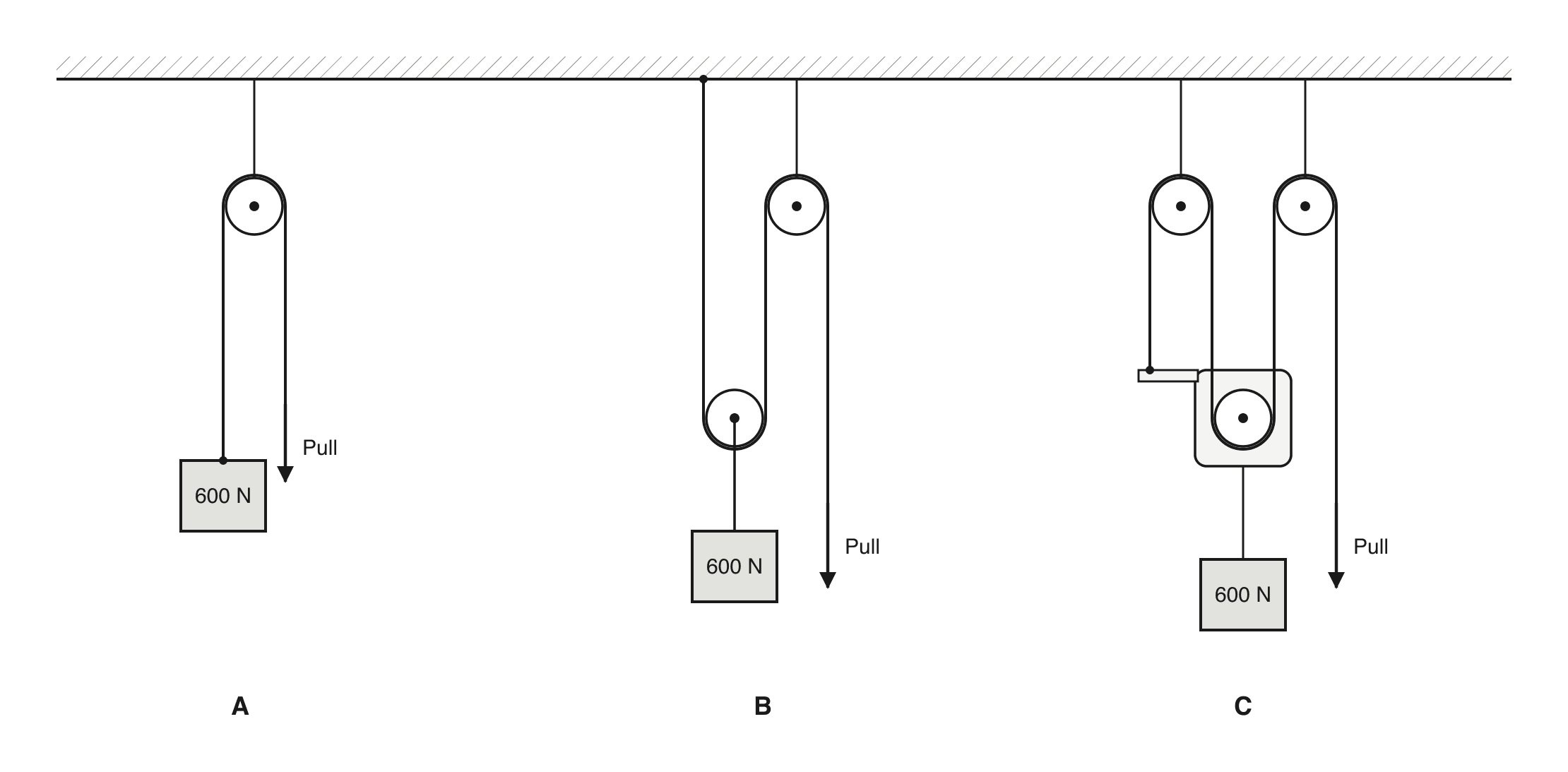
A rope running over pulleys pulls equally hard all along its length. A load is held up by every section of rope that runs up from it, or from the moving pulley it hangs on. If the rope and pulleys are light and turn freely, the pull needed at the free end of the rope is the load’s weight divided by the number of sections supporting it.
Raising the load by 1 m shortens every supporting section by 1 m, so the free end must be pulled that many metres. Figure 1 shows three pulley systems, A, B and C, each holding up a 600 N load.
Figure 1. Three ways to hold up a 600 N load
What Section 3 covers
Section III, Reasoning in Biological and Physical Sciences, draws on three subjects:
Chemistry (about 40%): general and physical chemistry, equilibrium, acids and bases, thermodynamics, kinetics, redox and a substantial amount of organic chemistry. See the chemistry and organic chemistry guides.
Biology (about 40%): cells and membranes, genetics, molecular biology, biochemistry and human physiology.
Physics (about 20%): mechanics, energy, waves, electricity, optics and fluids. See the physics guide.
Biology and chemistry are pitched at about first-year university level and physics at about final-year school level. The questions rarely test recall on its own. Most give you an unfamiliar scenario and ask you to reason from it.
Skills Section 3 rewards
Reading graphs and tables quickly, including log scales, multiple series and units you haven’t seen before.
Mental arithmetic and estimation. Without a calculator, rounding sensibly and working in powers of ten saves minutes.
Rearranging equations you’re given, and checking answers with units.
Spatial reasoning in organic chemistry, especially stereochemistry.
Pacing. At two minutes per question, it pays to recognise a time sink, make your best guess and move on.
101 short lessons in 12 syllabuses, each with a summary, something interactive to explore and a quiz. The first 4 are on the free plan.
1Mathematical Foundations9 lessonsFree
2Chemistry Foundations9 lessonsFree
3Chemical Equilibrium, Acids & Bases8 lessonsFree
4Energy, Thermodynamics & Kinetics6 lessonsFree
5Redox & Electrochemistry6 lessons
6Organic Chemistry & Stereochemistry10 lessons
7Cell Biology & Membranes7 lessons
8Genetics & Molecular Biology9 lessons
9Biochemistry & Metabolism9 lessons
10Human Physiology & Homeostasis8 lessons
11Physics Foundations12 lessons
12Experimental & Data Reasoning8 lessons
Common questions
What content does GAMSAT Section 3 cover?
Biology and chemistry make up most of the section, at about the level of first-year university, with physics at about the level of final-year school. Questions are mostly built around passages, graphs, tables and diagrams, so interpreting data matters as much as recall.
Can I do well in Section 3 without a science background?
Yes, but plan for it. Start with the maths and chemistry foundations, since so many questions rest on them, then move on to biology, physics and data reasoning. Daily practice with explanations helps the content stick.
Are there free GAMSAT Section 3 practice questions?
Yes. Get Into Med’s free plan gives you a new Section III unit every day with an explanation for every question, plus the first 4 Learn syllabuses. No credit card is required.